Your agent doesn't need more context. It needs the current context.
Similarity retrieval has no opinion about what's still true. That's not a ranking problem you can tune away — it's a missing edge in your data.
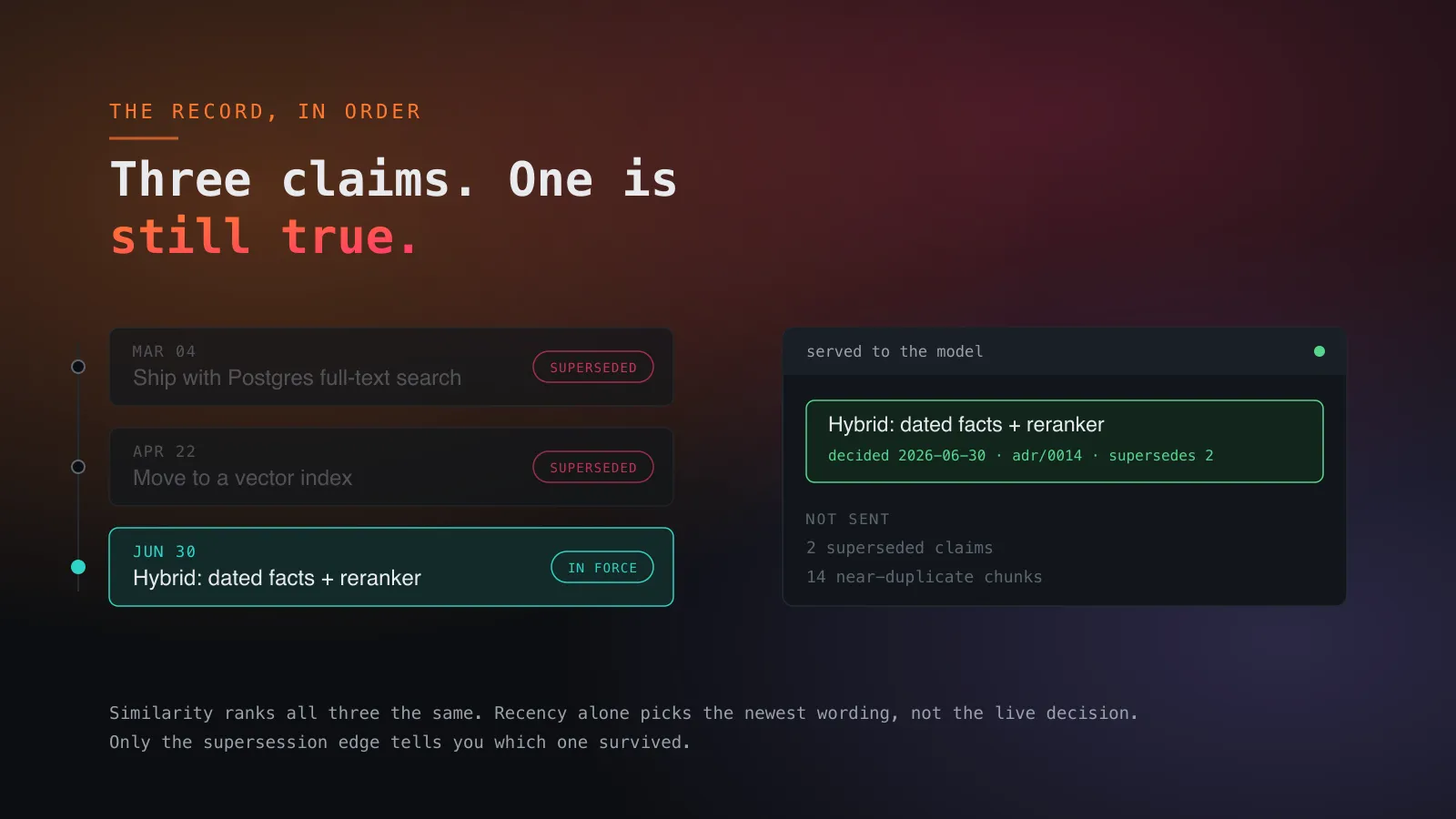
A team decides in March to ship with Postgres full-text search. In April they move to a vector index. At the end of June they settle on a hybrid: dated facts plus a reranker. All three decisions are written down. All three are in the wiki, the Slack export, and two design docs.
Ask an agent “how do we do retrieval?” and it will answer confidently, using whichever of the three happens to embed closest to your question.
Similarity has no opinion about truth
The failure here is easy to misdiagnose. It looks like a ranking problem, so it
gets treated like one — better embeddings, a reranker, a bigger k, a longer
context window. None of that helps, because none of it encodes the thing you
actually need to know: the March decision was retracted.
Cosine distance measures how alike two pieces of text are. Three descriptions of the same architectural question are extremely alike. That’s precisely why they all score well.
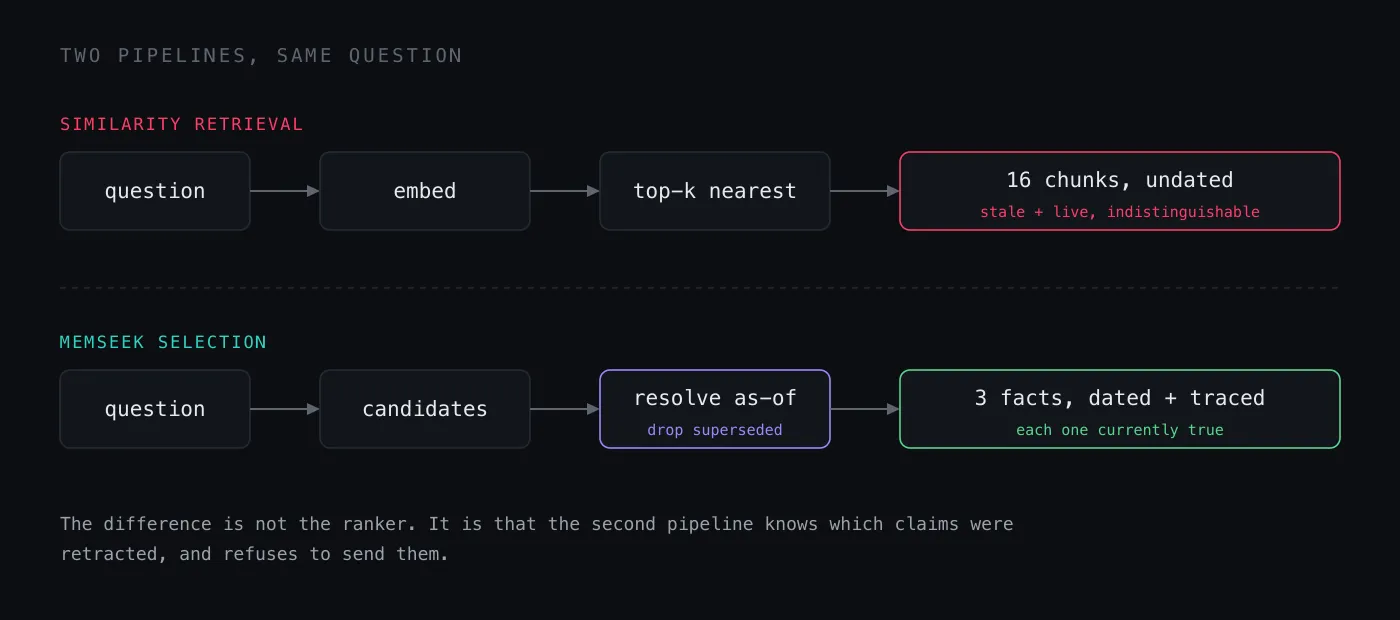
Recency-weighting is the usual next attempt, and it’s closer — but it answers the wrong question. Recency tells you which document was edited most recently, which is often a typo fix on a dead proposal. The June doc might be the oldest file in the set if the March one keeps getting touched.
What a memory layer owes the model
If the retrieval step returns claims rather than chunks, three things become possible that chunk-similarity can’t express:
| Similarity retrieval | Selection | |
|---|---|---|
| Unit | text chunk | dated claim |
| Ordering | distance score | validity interval |
| Retraction | invisible | an explicit edge |
| Provenance | the chunk’s file | the source that asserted it |
| Answer to “as of March?” | none | replay the graph at that timestamp |
That last row is the one that surprises people. Once supersession is a real edge in the data rather than an inference the model is expected to make, “what did we believe in March?” and “what do we believe now?” are the same query with a different timestamp.1
Concretely, the thing you hand the model stops looking like a pile of prose and starts looking like a short, checkable list:
{
  "as_of": "2026-07-24T00:00:00Z",
  "facts": [
    {
      "claim": "Retrieval is hybrid: dated facts + reranker",
      "asserted": "2026-06-30",
      "source": "docs/adr/0014-hybrid-retrieval.md",
      "supersedes": ["adr/0003", "adr/0009"]
    }
  ],
  "withheld": { "superseded": 2, "near_duplicate": 14 }
}
Three properties matter more than the shape:
- Every claim is dated. The model can reason about age instead of guessing.
- Every claim is traced. A wrong answer is a bug you can walk back to a file, not a vibe you have to re-prompt away.
- Withheld is counted, not silent. You can tell the difference between “nothing matched” and “we dropped fourteen restatements of the same thing.”
Where this leaves the context window
The pleasant side effect is that the payload gets small. Not because anything was compressed, but because near-duplicates and dead claims were never candidates. A context window spent on three current facts does more work than the same window spent on sixteen chunks, two of which contradict each other and none of which say when they were written.
We’ll write up the selection and scoring side of this next — how candidates get ranked once currency is a hard filter rather than a soft signal.
Footnotes
-
This is the same idea as a bitemporal database: one axis for when something happened, another for when you recorded it. Agent memory needs both for the same reason accounting does — you have to be able to reconstruct what was known at a point in time, not just what’s true now. ↩